Shri Mahaganapati Temple, Ranjangaon
Details of Shri Mahaganapati Temple, Ranjangaon .Located about 50 km from Pune on the Pune–Ahmednagar highway, the Mahaganapati Temple, Ranjangaon is one of the eight sacred shrines of the Ashtavinayak Yatra in Maharashtra. At this temple, Ganesha is worshipped as Mahaganapati, meaning “the Great G
ASHTAVINAYAK TEMPLES DETAILS & IMPORTANCE
Pravas Sukhacha
3/8/20262 min read
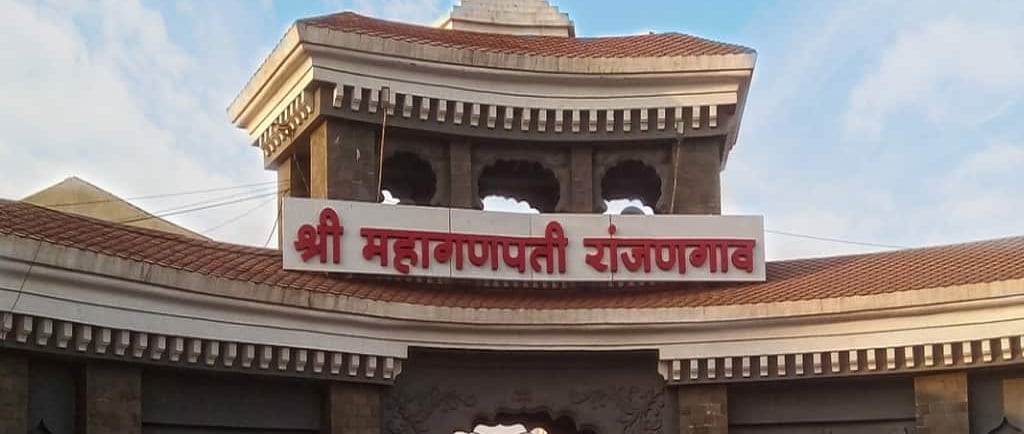
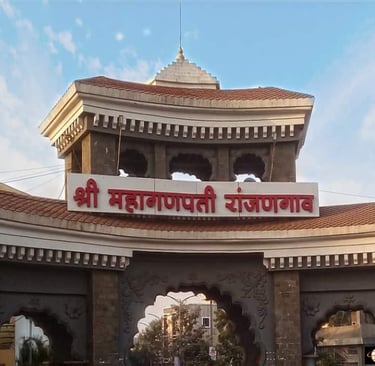
Shri Mahaganapati Temple, Ranjangaon
Located about 50 km from Pune on the Pune–Ahmednagar highway, the Mahaganapati Temple, Ranjangaon is one of the eight sacred shrines of the Ashtavinayak Yatra in Maharashtra.
At this temple, Ganesha is worshipped as Mahaganapati, meaning “the Great Ganesha.” Devotees regard this form as one of the most powerful manifestations of Ganesha, invoked for strength and success in difficult undertakings.
The Legend of Tripurasura
The mythology associated with Ranjangaon is connected with the story of the demon Tripurasura.
According to traditional legend, Tripurasura possessed three powerful cities—one of gold, one of silver, and one of iron. These cities moved through the sky and could only be destroyed when they aligned perfectly in a straight line.
Tripurasura used this power to trouble the gods and disturb cosmic order. To end this chaos, Shiva prepared for battle.
However, it is believed that Shiva initially failed because he had not first invoked Ganesha, the remover of obstacles. After realizing his mistake, Shiva prayed to Mahaganapati for guidance and blessings.
With Ganesha’s help, Shiva was able to release a single powerful arrow that destroyed all three cities at once, bringing an end to Tripurasura’s rule. Because Shiva invoked Ganesha here before achieving victory, the place became associated with the worship of Mahaganapati.
This legend is an important part of the temple’s spiritual significance.
The Idol of Mahaganapati
Inside the sanctum is the main idol of Ganesha, which is traditionally believed to be Swayambhu, meaning naturally manifested.
Key features of the idol include:
The idol faces east, which is considered auspicious in temple architecture.
The trunk is turned toward the left.
The idol is seated in a cross-legged posture and coated with Shendur (vermilion), a common practice in Maharashtra.
On both sides of the idol are representations of Riddhi and Siddhi, symbolizing prosperity and spiritual power.
The Tradition of the “Mahotkat” Form
There is a well-known local belief connected with the temple.
According to this tradition, an older and more powerful form of Mahaganapati called Mahotkat once existed here. This form is described in temple lore as having multiple arms and trunks and is sometimes said to have been hidden in a basement chamber during periods of invasion.
However, temple authorities have stated that there is no confirmed evidence of such an idol currently stored in the cellar, and the story remains part of local tradition rather than verified history.
Temple Architecture and Maratha Patronage
The temple structure seen today reflects several phases of development.
Historical records suggest that the temple dates back to roughly the 9th–10th century, though it underwent major construction and renovation during the Maratha period.
Key architectural features include:
The Entrance Gate
The temple has a large entrance gateway guarded by statues of Jay and Vijay, the celestial gatekeepers.
Peshwa Contributions
The sanctum of the temple was developed during the time of Madhavrao I, a prominent ruler of the Maratha Empire. Other Maratha nobles also supported the temple’s construction and maintenance.
Sunlight Alignment
The temple is designed so that during certain periods of the year, particularly around the Dakshinayan (the sun’s southward movement), the sun’s rays fall directly on the idol, illuminating the sanctum.
Spiritual Importance for Pilgrims
Among the eight temples of the Ashtavinayak pilgrimage, the shrine at Ranjangaon represents the majestic and powerful aspect of Ganesha.
Devotees often pray here when they are facing significant challenges in life or when beginning important ventures.
Traditionally, Ranjangaon is visited near the end of the Ashtavinayak pilgrimage. However, according to the customary order of the yatra, pilgrims must return to Mayureshwar Temple, Morgaon after completing all eight temples to formally conclude the journey.
This return symbolizes the completion of the sacred spiritual cycle.
Contact
Reach out for bookings or any questions
Phone
+91 90163 49133
© 2026. All rights reserved
A Collaborative Initiative By Pravas Sukhacha™ & Royal Holidayj